


What is our natural farming?
Our natural farming grows Ka’u coffee without chemical fertilizer: soil analysis, a clay spray, a peanut ground cover and bees.
Each of these is a growing technique that John arrived at through years of trial and error, and each is gentle on people and on nature.
Updated
Taking a coffee already established as "Ka'u coffee" and improving it with care
John took a coffee whose taste was already established as “Ka’u coffee” and improved it through natural farming that draws on the abundance of Hawaii. In the coffee fields we constantly analyze the soil for its makeup and acidity. During cultivation we use the power of nature, spraying clay and releasing beneficial insects, and we use nutrients that do not rely on chemical fertilizer.
What do we do in natural farming, and why?
| Method | Purpose | What we do |
|---|---|---|
| Soil analysis (makeup and acidity) | Nutrient management without chemical fertilizer | We constantly analyze the makeup and acidity of the soil in the coffee fields and use nutrients that do not rely on chemical fertilizer |
| White clay spray | Control of the coffee beetle, a pest | Instead of chemicals, we spray white clay on the leaves |
| Perennial peanut ground cover | Weed control, drainage and nitrogen supply | We plant this yellow-flowered plant at the base of the trees; it absorbs excess rainwater and sends nitrogen from its roots |
| Bees from our own apiary | Natural pollination of the coffee blossoms | We keep an apiary on the farm so that every blossom is pollinated naturally |
All four methods come from our Commitment page and the article “Not a weed: the role of the ground cover at the base of the coffee trees.” The semi-washed process after harvest continues the story on the From Harvest to Cup page.

Pest control with a clay spray
The enemy of coffee farming is a pest called the coffee beetle. Instead of chemicals, we spray white clay on the leaves to control it.
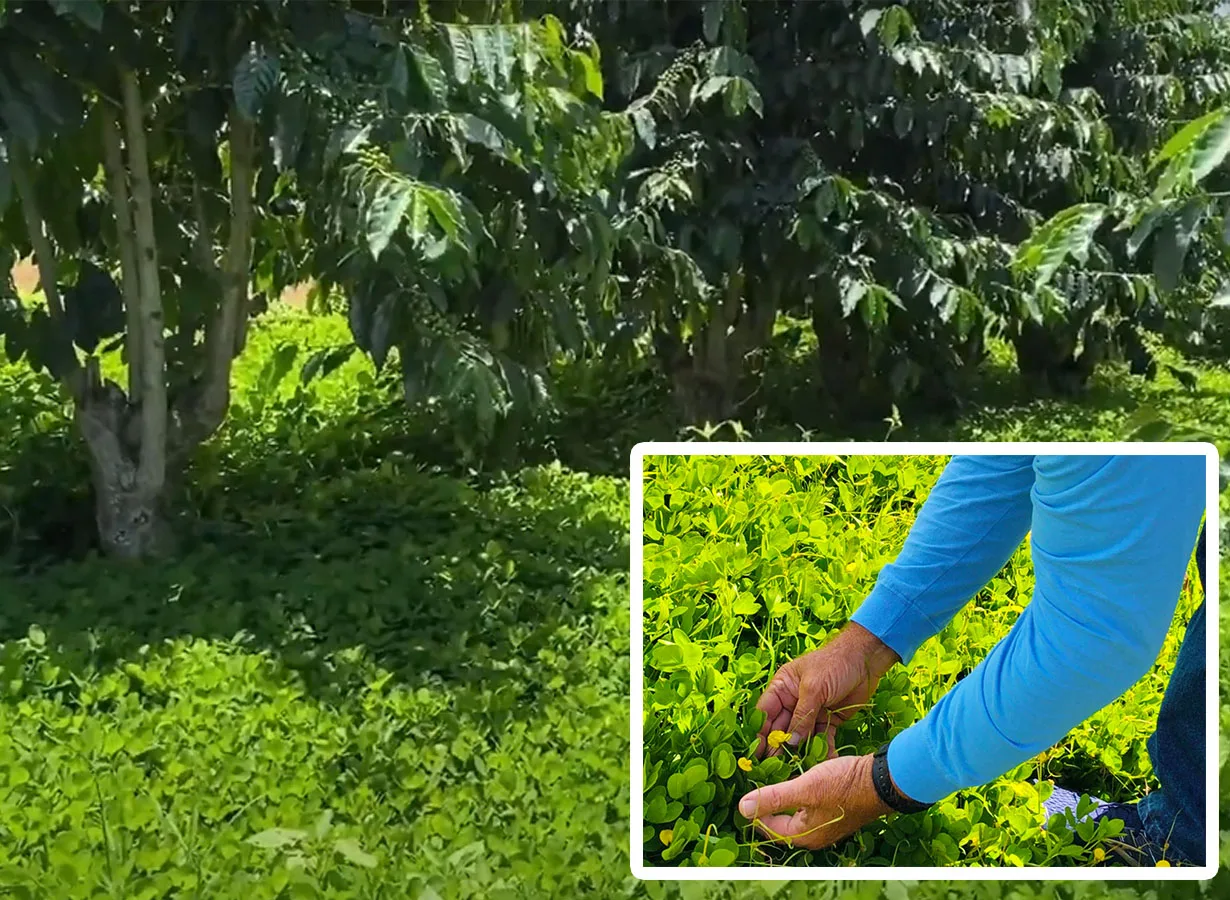
Drainage control with a perennial peanut ground cover
The yellow-flowered plant that covers the ground between the coffee trees is not a weed. It is a special plant that John propagates on part of the farm and plants at the base of the trees. Its proper name is perennial peanut. It is a kind of peanut plant, but we do not grow it for nuts.
One purpose is to protect the roots of the coffee trees. Coffee roots are easily damaged when rainwater collects around them. This plant absorbs the excess rainwater and keeps the soil at just the right moisture. Its roots also send nitrogen into the ground, which keeps the coffee trees healthy. It suppresses weeds as well.
The idea came from John’s days as a dairy farmer, before he grew coffee, when he saw the condition of cows that had eaten this plant. Not every farm in the Ka’u district does this, but John shares the knowledge with other farms, telling them “here is what you should try.”
Pollination by bees from our own apiary

To pollinate every single coffee blossom naturally, John’s farm keeps an apiary. The video shows the bees on the farm and the measuring tower.
On pesticides and chemicals
No pesticides at all are used on John’s coffee trees (from the article “Truly magic! Tea from a coffee tree?”). The harvest is done by hand, picking only the red, ripe cherries. Coffee trees that grew under the sun pouring down from Hawaii’s deep blue sky, and red cherries raised by natural farming without any chemicals: their seeds become the coffee beans (from the article “Coffee beans are actually seeds!”).
Care after the harvest: the semi-washed process
John’s care continues after the harvest. With the “semi-washed process,” which leaves the sticky fruit pulp on the bean during processing, he produces coffee beans steeped in the unique aroma and sweetness of Ka’u coffee.
Coffee trees bear bright red cherries that look like actual cherries. When the coffee bean, the seed, is taken out, the usual washed process rinses away all of the fruit pulp. But it is the pulp around the seed that holds the natural sweetness and flavor. See From Harvest to Cup for the details of each step.


Frequently Asked Questions
What is Ka'u coffee?
How should I store the beans?
Taste naturally farmed Ka'u coffee
Key Points on This Page
- Our natural farming has four methods: analysis of the soil’s makeup and acidity, a white clay spray against the coffee beetle, a perennial peanut ground cover (weed control, drainage, nitrogen) and natural pollination by bees from our own apiary.
- No pesticides at all are used on John’s coffee trees, and only the red, ripe cherries are picked by hand.
- After the harvest, the semi-washed process leaves the sticky fruit pulp on the bean so that the unique aroma and sweetness of Ka’u coffee soak in.
Related articles (in Japanese)
English versions of our blog are planned for a later phase. The articles below are in Japanese.